One question we often ask game studios is:
“But is our game actually suitable for China?”
The most common answer is surprisingly consistent.
“We’re planning to hire a local to run our social channels and reach out to creators.”
At first glance, that sounds perfectly reasonable. If you’re entering China, hiring someone local seems like the obvious solution.
But we’ve seen this story play out many times:
- The studio launches official Chinese accounts.
- They publish dozens of posts before and after release.
- The accounts attract fewer than a hundred followers.
- Engagement remains in the single digits.
- Steam data shows little movement from Chinese players.
Eventually, the team reaches the same conclusion.
“Maybe our game just isn’t a good fit for China.”
In reality, a different explanation is often more accurate.
The right players simply never discovered your game.
Hiring Local Talent Is a Great Start—But Only the Beginning
To be clear, studios that invest in Chinese marketing are already ahead of most overseas studios.
Setting up local channels and communicating in Chinese shows genuine commitment.
But language alone doesn’t create visibility.
A typical in-house local marketing hire is already responsible for translating marketing assets, publishing content, replying to comments & DMs, and contacting creators.
That leaves very little time for strategic work.
When are they supposed to study platform algorithms, adapt content for different platforms, experiment with new approaches, analyze competitors, and continuously refine the campaign strategy?
And that’s where many campaigns begin to stall.
Because succeeding on Chinese social platforms isn’t just about speaking Chinese.
It’s about understanding how Chinese social media actually works.

Speaking Chinese ≠ Understanding Chinese Social Media
Most native speakers can absolutely translate copy, publish posts, and manage daily account activity. Those are execution tasks.
Strategy is something entirely different.
Imagine spending hours cooking an incredible meal. Then placing it on the table and assuming customers will smell it and somehow find their way to your restaurant.
Publishing content is only the presentation.
Marketing is creating the reason people walk through that door.
Unlike Western platforms, recommendation systems across Chinese social media are heavily shaped by platform culture, user behavior, and constantly evolving algorithm preferences.
There is no official playbook explaining exactly what succeeds.
Most effective strategies come from running campaigns across different game genres, analyzing performance data, and continuously adapting to platform behavior.
Copy-and-Paste Marketing Rarely Works
Another common mistake is treating every platform the same.
One asset gets localized once…
…then copied to Bilibili, RedNote, Douyin, HeyBox, and every other platform.
From the studio’s perspective, that’s efficiency.
From the platform’s perspective, it often looks like repetitive promotional content.
Different platforms attract different audiences—and reward different kinds of content.
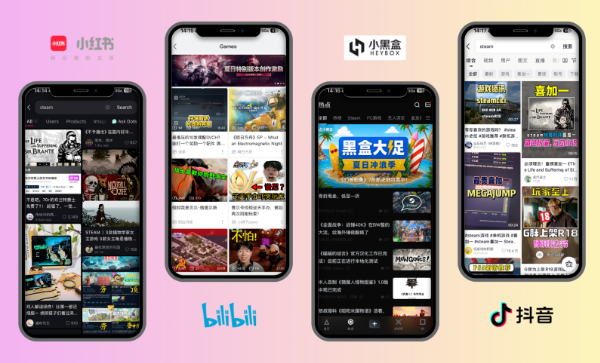
Content that performs well on one platform may receive almost no distribution on another.
Meanwhile, the studio only sees disappointing monthly reports and concludes:
“China probably isn’t the right market.“
When in reality, the strategy—not the game—was the problem.
Shadow Limiting Is More Dangerous Than Account Suspension
One project we encountered illustrates this perfectly.
A Chinese social manager contacted us through RedNote, asking whether we’d be interested in publishing coverage of their game.
The outreach message looked professional. It included a game introduction, a collaboration proposal, and a Steam link.
Clearly something prepared for large-scale outreach.
Curious, we clicked the profile and opened the game’s official RedNote account.
Decent artwork.
Professional branding.
Almost no engagement.
Most posts had fewer than 10 likes.
Then we noticed something unexpected. RedNote displayed an automated warning on their account.
“This account may pose a fraud risk. Please exercise caution!“
Nothing looked suspicious from the studio’s perspective. Yet the platform had quietly classified the account as high risk.
No suspension.
No explanation.
Just dramatically reduced visibility.
The team managing the account likely had no idea what had triggered it.
The Biggest Risk Isn’t Breaking the Rules
Many overseas studios assume that if they avoid political or legal issues, they’re safe. Unfortunately, Chinese social platforms work differently.
Many visibility penalties are triggered by ordinary marketing behavior, such as advertising language, directing traffic to Steam, repetitive promo content, mass direct messaging, sensitive wording, etc.
Instead of banning the account, platforms often reduce recommendation distribution gradually and quietly.
Until the account reaches almost nobody outside its existing followers.
Recovering from that situation can take months.
So What’s the Alternative?
The answer isn’t simply posting more often.
Nor is hiring a more experienced Chinese social media manager.
Before any content is created, several strategic decisions need to happen.
1. Match the Game to the Platform
Not every platform fits every game.
Art style. Genre. Narrative. Core gameplay. Audience profile…
All influence where your target audience naturally gathers.
The goal isn’t to be everywhere. It’s to be where your players already are.
Insider Talk
We’ve seen many Chinese studios launch official accounts across 4 or 5 platforms at the same time (yes, “the more, the merrier” is a global belief).
After only a few months, almost every account looked neglected—not because the team lacked commitment, but because there simply wasn’t enough time to create platform-specific content, manage each community, and keep every channel active.
Even for studios based in China, social media marketing is a specialized discipline—not just another operational task.
2. Match the Content to the Platform
A gameplay breakdown might perform brilliantly on Bilibili, but the same content would likely struggle on RedNote.
Likewise, beautiful screenshots that work well on RedNote often generate little interest on HeyBox.
Each platform rewards different storytelling and presentation styles.
3. Build Platform Trust Before Launch
One of the biggest (and most common) mistakes studios make is opening official accounts 2 weeks, even days (!), before release.
Chinese platforms reward consistency.
Accounts that gradually establish credibility over several months before launch generally receive much stronger organic distribution than accounts that suddenly begin posting promotional content.
Marketing in China Isn’t Just Translation
China doesn’t lack players. Even highly niche genres can find their passionate communities.
The challenge is helping those players discover your game.
Hiring someone who speaks Chinese is relatively easy.
Finding someone who understands Chinese gaming communities, platform behavior, creator ecosystems, and social strategy is much harder.
Those are two very different skill sets.
And the difference between them can determine whether your game quietly disappears…
…or finds the audience it deserves.
One Final Question
If you’re preparing to enter China, ask yourself one simple question.
Are we hiring someone who speaks Chinese…
…or someone who understands Chinese game marketing?
The answer may have a far greater impact on your campaign than you expect.
🐼🎮🐼🎮🐼🎮
China is not a market you can unlock with localization alone. It requires the right positioning, right platforms, and right understanding of target audiences.
Panforia helps global studios navigate China’s gaming ecosystem—from market audit and strategic planning to marketing execution and community building. If you are considering China for your next growth opportunity, let’s start the conversation.
Written by QR Code | Edited by Su